Why Chocolatey Is the Backbone of Our App Delivery
Package managers changed how developers ship code. Chocolatey brings that same power to Windows endpoint management — and it's the engine behind everything we deploy.
The Package Manager Windows Always Needed
In the Linux world, package management has been solved for decades. Need a tool? apt install or yum install and you're done. Dependencies resolve automatically, updates roll out cleanly, and everything is repeatable.
Windows never had that. Instead, IT teams downloaded MSIs from vendor portals, wrapped them in custom scripts, and hoped the silent install switches they found on a forum post from 2014 still worked. Every application was a one-off project.
Chocolatey changed that. It brought real package management to Windows — and once we built our delivery system on top of it, we never looked back.
What Makes Chocolatey Different
Chocolatey isn't just a download manager. It's a full package lifecycle tool that handles installation, configuration, updates, and removal with a single consistent interface.
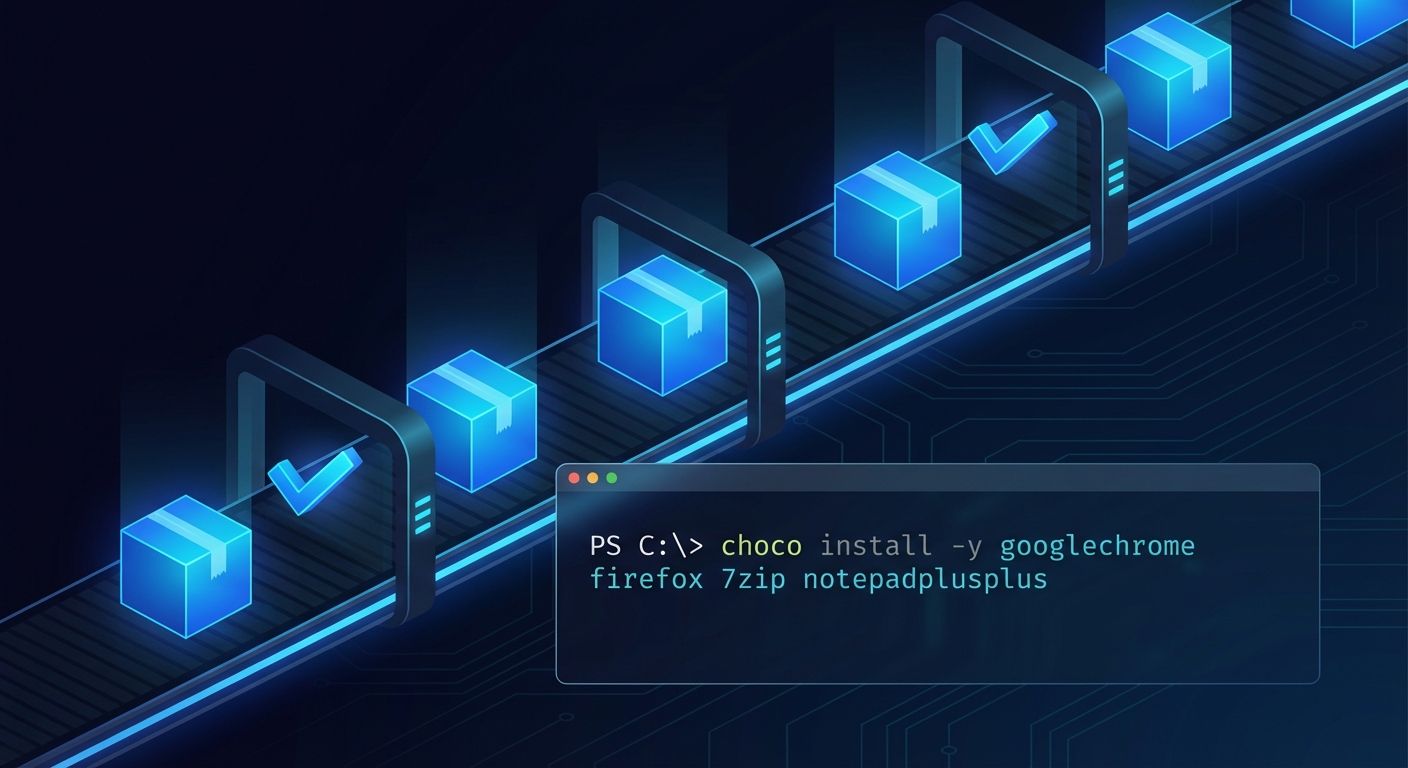
Every Chocolatey package includes the silent install switches, dependency chains, and pre/post-install scripts baked right in. When we run choco install firefox -y, we're not just downloading a binary. We're executing a tested, versioned, repeatable deployment that handles every edge case the package maintainer has already solved.
That consistency is everything. Whether we're deploying to one laptop or a thousand endpoints, the command is the same and the result is the same.
Our Internal Package Repository
The public Chocolatey Community Repository covers thousands of popular applications, but enterprise environments need more control. That's why we maintain our own internal package repository.
Our repository contains every application we deploy — both packages we've customized from the community feed and proprietary line-of-business applications we've packaged ourselves. Every package is version-pinned, tested against our standard image, and validated for silent installation and conflict-free operation.
This gives us a single source of truth. When a role-based configuration says a user needs Adobe Acrobat Pro, Chocolatey pulls it from our repository with every setting, license key, and configuration preference already embedded. No manual steps. No guesswork.
Automation That Actually Works
The real power of Chocolatey shows up in automation. Because every package follows the same interface, we can script entire endpoint builds without worrying about application-specific quirks.
A new hire's laptop build looks like this: the role-based configuration determines which applications they need, generates a Chocolatey install list, and executes them in dependency order. Applications install silently with all preferences pre-configured. The entire software stack deploys without a technician touching the keyboard.
When an application needs updating, the same simplicity applies. choco upgrade handles the version transition, respects dependencies, and maintains configuration. No repackaging. No rewriting install scripts. No hoping the new version uses the same silent switches as the old one.
Version Pinning and Rollback
One of the biggest headaches in endpoint management is version control. Evergreen applications update themselves on their own schedule, creating environments where ten users on the same team run ten different versions of the same tool.
Chocolatey gives us explicit version control. We pin applications to tested versions and promote updates on our schedule, after validation. If an update causes problems, rollback is straightforward — we redeploy the previous package version. No need to hunt for old installers or reverse-engineer uninstall procedures.
This is especially critical for applications with compliance requirements. When an auditor asks what version of a tool is deployed across the fleet, we have a definitive answer — not a best guess.
Why Not SCCM or Intune Alone?
Microsoft's deployment tools are powerful for distribution, but they don't solve the packaging problem. SCCM and Intune need something to deploy — and that something still has to be a properly packaged, silently installable application with the right configurations.
Chocolatey is the packaging layer. It handles the hard part: figuring out silent install switches, managing dependencies, embedding configurations, and ensuring clean uninstalls. The deployment platform just needs to run choco install and Chocolatey handles the rest.
This separation of concerns makes our pipeline more portable and more resilient. If a client uses Intune, it works. If they use a different MDM, it still works. The Chocolatey package doesn't care how it gets invoked — it just does its job consistently every time.
The Compound Effect
Every application we package in Chocolatey is an investment that pays dividends on every future deployment. A package built once deploys to every endpoint that needs it, updates cleanly when new versions release, and uninstalls without leaving artifacts behind.
Over time, this compounds. Our package repository grows, our deployment scripts get simpler, and the time from "new hire" to "fully productive" drops. What used to be a full day of manual software installation becomes a process that runs itself while the technician moves on to the next machine.
That's why Chocolatey isn't just a tool we use. It's the foundation everything else is built on.
Ready to modernize?
Let's discuss how intelligent IT delivery can transform your organization.
Contact Us